
Most service portals do not fail in a dramatic way.
They are not always broken. The homepage still loads. The catalogue is there. Search exists. Forms submit. Tickets get created.
And yet, people still bypass the portal.
They email the service desk. They send a message in Teams. They call someone directly. They choose the generic option and hope it lands with the right team. The service desk still spends time triaging work that should have arrived more cleanly in the first place.
That is why portal failure is often easy to miss. On paper, the portal is live. In practice, it is no longer acting like a trusted front door.
The portal is live, but behaviour says otherwise
This is a pattern many teams recognise.
The portal exists and may even look reasonably good. Real effort has gone into the catalogue, the homepage, and the forms. But when you look at actual behaviour, the signals tell a different story.
Users still avoid the structured path. Generic requests stay high. Teams reassign work. Fulfilment groups chase missing details. People use the portal when they have to, but not always when they should.
That is the quiet failure pattern.
The issue is not simply that the portal is unavailable. It is that the portal does not feel like the safest or most reliable way to get help.
Quiet failure is built from small friction
Portals rarely lose trust because of one major flaw. More often, they lose trust through a build up of small experience problems.
These usually look familiar:
• labels that do not match user language
• too many choices on the homepage
• forms that ask for effort without helping enough
• unclear request versus incident paths
• vague updates after submission
• outcomes that vary depending on who receives the work
Each issue on its own can seem minor. Together, they change behaviour.
This is what makes portal failure so frustrating. The portal may be technically functional. The forms may work as designed. The catalogue may be broad enough. But users do not assess the portal as a platform team would. They judge it by whether it helps them move forward with confidence.
If the portal repeatedly creates uncertainty, hesitation, or extra effort, people start finding other ways in.
What users learn when the portal does not feel reliable
Users do not usually make a formal decision to reject the portal. They learn from experience.
They learn that the generic option is safer than guessing. They learn that email feels more certain because someone will see it. They learn that a Teams message feels faster than navigating a pathway they do not fully trust. They learn that if they want confidence, they may need to follow up outside the portal anyway.
Bypass becomes learned behaviour.
That matters, because it changes how the problem should be understood. Low portal usage is not always resistance to change. Often, it is a rational response to a channel that feels less reliable than the alternatives.
Most users are not trying to avoid process. They are trying to reduce risk.
They want to know where to start. They want to feel reasonably sure they are choosing the right path. They want the request to land in the right place. They want to know what happens next. When the portal does not provide that confidence, they switch to whatever does.
That is why quiet portal failure is really a trust issue before it is a technology issue.
The operational cost of quiet failure
When a portal stops behaving like a trusted front door, the cost is not limited to adoption metrics.
The work shows up downstream:
• Generic intake hides what people are actually asking for
• Misrouted work bounces between teams
• Missing details trigger back and forth before fulfilment can begin
• The service desk becomes a human routing layer
• Users raise requests in one channel and chase progress in another
This creates effort on both sides:
For users, the experience feels unclear and unpredictable. For support teams, the workload becomes noisier and more manual than it should be. Work is not just arriving. It is arriving with ambiguity attached.
That is often why portal frustration can feel larger than the portal itself. The visible issue may be bypass or generic tickets, but the real impact is extra handling, extra reassignment, extra clarification, and lower confidence in the service experience overall.
A portal does not need to be completely broken to create that cost. It only needs to be unreliable often enough that people stop depending on it.
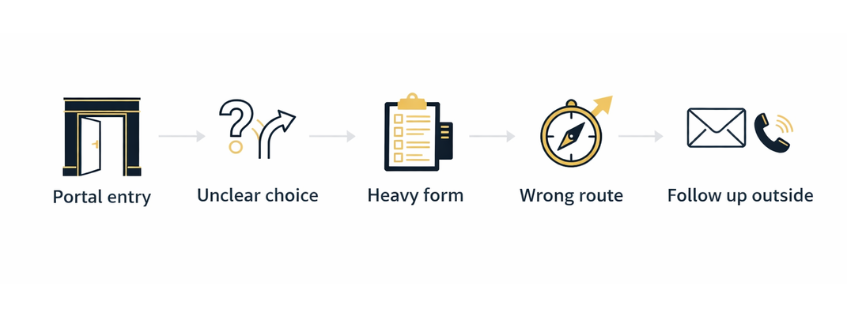
Small friction points can quietly turn portal use into bypass, rework, and manual effort.
The real issue is trust, not just adoption
Portal discussions are often framed as adoption problems.
How do we get more users into the portal. How do we reduce email. How do we increase self service usage.
Those are fair questions, but they sit slightly downstream from the real issue.
The deeper question is whether users trust the portal enough to start there and stay there.
That trust is built through clean entry, understandable pathways, reasonable form effort, meaningful updates, and consistent outcomes. If those things are weak, adoption suffers. But adoption is the symptom, not the cause.
A portal becomes a trusted front door when it helps work enter cleanly, route properly, and move forward in a predictable way.
That is why some portal improvement efforts stall. They focus on the portal surface while the deeper problem sits in the intake experience. A cleaner interface may help, but it will not solve bypass if the pathways are still unclear, the generic route still feels safest, and fulfilment still depends on manual clarification.
Portal adoption is often a trust problem wearing a usage metric.
Quiet failure can be reversed, but only if you look at the right problem
The good news is that quiet failure does not always mean the portal needs a rebuild.
In many cases, the issue is not the whole portal. It is a handful of common journeys, weak intake paths, unclear labels, missing key fields, or poor expectation setting that are gradually training people to go elsewhere.
That is why it helps to look beyond whether the portal is live, modern, or feature rich.
A better question is this: Is the portal helping work enter cleanly, route properly, and feel reliable to users?
That is where the real signal sits.
Because service portals rarely fail all at once. They fail quietly, when small frictions teach users that another path feels safer.
And once that behaviour takes hold, the portal may still exist, but it is no longer the front door.
Want a quick signal check?
If your portal is live but people still bypass it, the issue may not be adoption alone. It may be a trust problem building earlier in the intake journey. My Portal Experience Quick Check is designed to help teams test whether their portal is acting like a reliable front door.
If the quick check points to deeper intake and routing issues, the next step may be a focused Portal Intake and Experience Assessment.