
When an ITSM portal is underperforming, the first response is often to look at the portal itself.
The homepage may need tidying. The catalogue may feel hard to navigate. There may be too many clicks, unclear labels, weak search, or features that are not being used well. Sometimes those issues are real, and they do need attention.
But in many cases, that is only part of the picture.
A portal can look like the problem while the real issue sits deeper in the intake experience behind it.
That is why a better portal review does more than assess the screen in front of the user. It looks at whether the portal is actually helping work enter cleanly, route properly, and feel reliable to the people using it.
Why portal reviews can miss the real issue
Traditional portal reviews often focus on the visible layer of the experience.
That usually means looking at things like:
• homepage structure
• catalogue organisation
• number of clicks
• item clarity
• navigation
• enabled features
• overall usability
That work is still useful. It can reveal real friction and improve the experience.
But on its own, it does not always explain why people still bypass the portal, why generic requests stay high, or why support teams continue doing manual triage behind the scenes.
A portal can be visually improved and still fail to change behaviour.
That is because the real issue is not always the portal surface. Often, it is the intake experience underneath it.
The better question to ask
A more useful assessment starts with a different question.
Not just:
Is the portal well designed?
But also:
Is the portal helping work enter cleanly, route properly, and feel reliable to users?
That shift matters because portal performance is shaped by more than layout and design. It is shaped by what happens from the moment a user needs help to the moment the work lands where it should. That is why I now think about this work less as a broad portal review and more as an intake and experience assessment.
Traditional portal reviews look at the portal itself. This approach looks at whether the portal is helping work enter cleanly, route properly, and feel reliable to users.
What a better portal assessment should include
A better assessment looks at the portal, but it also looks beyond it.
That includes:
• entry – where work is really coming in from today
• choice – whether users can tell which path is right
• detail – whether the request captures what teams need to act
• routing – whether work reaches the right team first time
• trust – whether updates and outcomes make the portal feel reliable
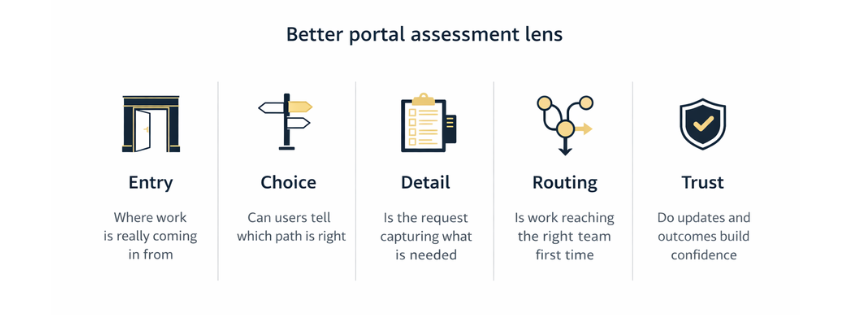
A better portal assessment looks beyond the portal surface and examines entry, choice, detail, routing, and trust.
This is where the quality of the experience is really decided.
If users do not know where to start, they hesitate. If the choices feel risky, they choose the generic option. If forms miss key detail, fulfilment teams chase information later. If routing is inconsistent, work bounces between teams. If updates are weak, users follow up outside the portal.
In all of those cases, the portal may appear to be the issue. But what is actually failing is the intake experience.
Why some portal improvements do not change much
This is why many portal refresh efforts produce only partial results.
A cleaner homepage may improve first impressions. Better labels may help a little. A more modern look and feel may make the portal more appealing.
But cosmetic improvements do not solve structural intake weakness.
If the generic path still feels safest, if users still struggle to choose the right route, if the right fields are still missing, and if teams still rely on manual triage, then the portal may look better without working much better.
That is often the gap.
The portal has been improved visually, but the intake logic behind it is still weak.
And when that happens, user behaviour does not shift in a meaningful way.
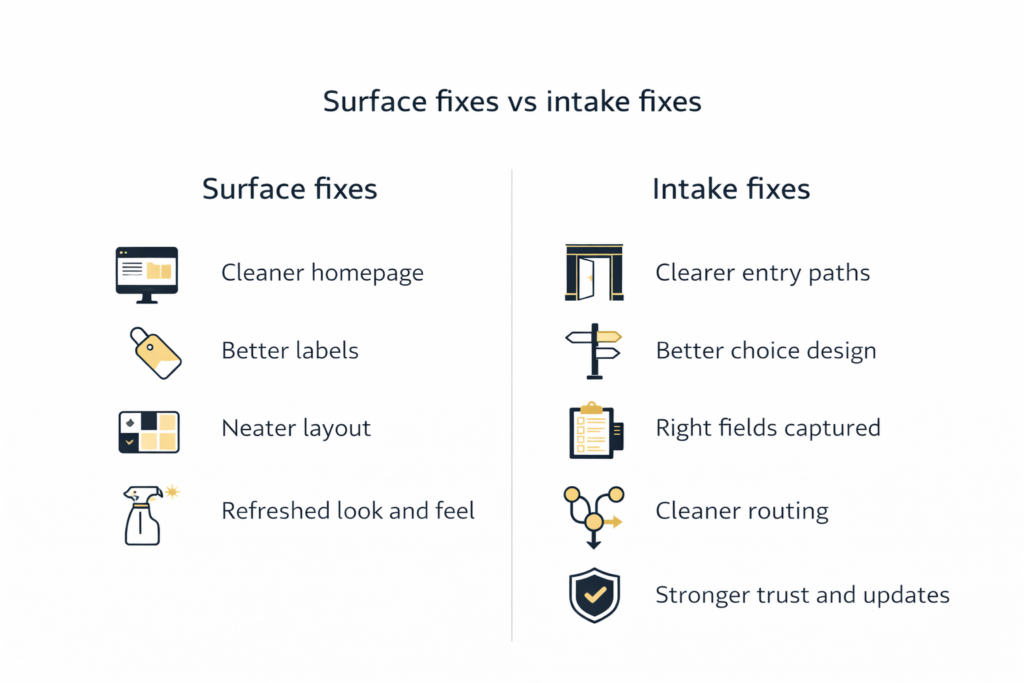
Surface improvements can improve appearance. Intake improvements are what change behaviour.
A better way to improve ITSM portals
The most useful portal improvements usually start with intake reality.
That means understanding:
• where work really enters today
• where users are bypassing the intended path
• where generic intake is masking real demand
• where missing detail creates follow up
• where requests are bouncing between teams
• which journeys create the most friction and manual effort
From there, portal improvement becomes much more practical.
Instead of trying to improve everything, you can focus on the journeys, decisions, and handoffs that matter most. You can simplify the paths people actually use. You can tighten the forms that create the most rework. You can fix the points where trust is being lost.
That tends to lead to better outcomes than a portal refresh alone, because it addresses the reasons behaviour broke in the first place.
Final thoughts
A good ITSM portal assessment should absolutely look at the portal itself.
But it should not stop there.
If the goal is to improve adoption, reduce bypass, and lower manual effort, the real question is not only whether the portal looks better. It is whether the intake experience behind it is working better.
That is the shift that leads to stronger fixes.
Because a better portal is useful. But a better intake experience is what actually changes behaviour.
Want a quick signal check?
If your portal is live but bypass, generic intake, or manual triage are still common, my Portal Experience Quick Check is a simple way to test whether the issue sits in the intake experience, not just the portal surface.
If the issues run deeper, the next step may be a more focused Portal Intake and Experience Assessment.