
Most ITSM platforms have reports.
They can show how many tickets were raised.
How many requests were completed.
How many incidents breached SLA.
How much work is sitting in the backlog.
Those reports are useful. But they do not always answer the more important question: What should we improve next?
That is where reporting often falls short.
A platform can have dashboards, charts, filters and scheduled reports, but still leave leaders unclear about where service management is improving, where friction remains, and where effort should go next.
Reporting should not only describe activity. It should support better decisions.
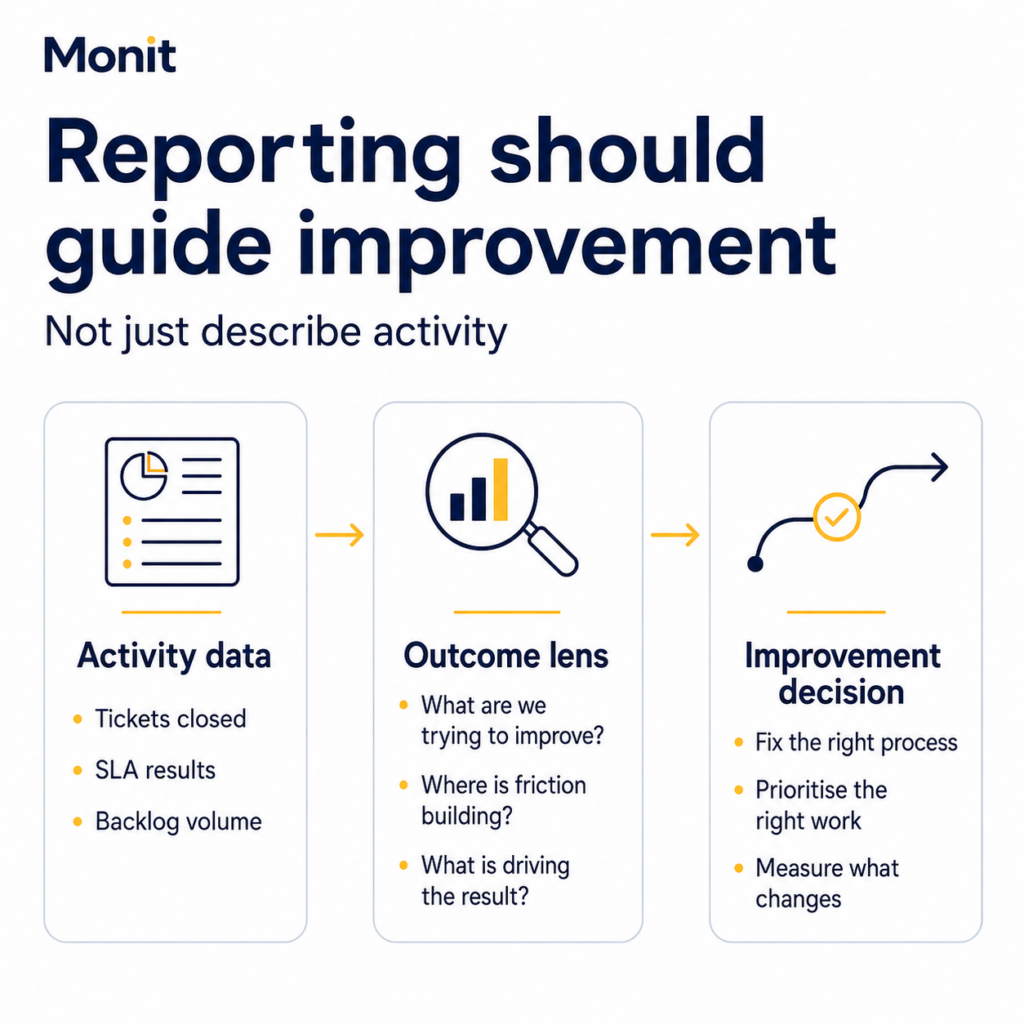
Activity is not the same as improvement
A lot of reporting shows what happened.
Tickets closed.
Incidents resolved.
Requests completed.
Changes approved.
SLA performance tracked.
These measures matter. They help teams understand volume, workload and service performance.
But on their own, they can create a narrow view.
A team might close more tickets and still be carrying avoidable work.
A process might meet SLA while still frustrating users.
A dashboard might show request volume without showing why work is slow.
A backlog might reduce while the same issues keep returning.
Activity reporting tells you how much work moved through the system.
Improvement reporting helps you understand whether the system is getting healthier.
Start with the outcome
Better reporting starts before the dashboard.
It starts with the outcome the organisation is trying to improve.
Before creating another report, ask:
• What are our service management objectives?
• What do executive stakeholders want to change?
• Which processes influence those outcomes?
• What would show whether improvement is happening?
• Which decisions should this reporting support?
This matters because reporting can easily become a collection of available data rather than a view of useful insight.
If the goal is faster fulfilment, request volume alone is not enough. You may need to see approval delays, missing information, waiting time, reassignment and the points where work stops moving.
If the goal is better portal adoption, portal visits alone are not enough. You may need to see generic request usage, email bypass, abandoned forms, unclear categories and tickets that need manual rerouting.
If the goal is safer change, completed changes alone are not enough. You may need to see emergency changes, failed changes, post implementation incidents, missing risk information and repeated approval delays.
The point is simple. Good reporting starts with the decision leaders need to make, not the chart the platform can produce.
Leading indicators matter
This is where leading and lagging indicators become useful.
Lagging indicators show the result. They look at what already happened, such as resolution time, SLA achievement, backlog volume, completed requests or closed incidents.
These measures are useful, but they often tell the story too late.
Leading indicators show the behaviours or process signals that shape the result. They help teams see what is driving the outcome before the final number appears.
For example, average resolution time may show how long work took. But intake quality, reassignment rates, approval delays, missing information and repeated follow up questions may show why the work took that long.
That is what makes leading indicators useful. They help leaders move from “What happened?” to “What is causing it?” and then “What should we change?”
This is where reporting becomes more useful.
Reports should guide action
A useful report should help someone decide what to do.
That might mean deciding which service journey needs attention, which approval path is creating delay, which category is causing rework, or which improvement should be prioritised next.
Useful reporting should help answer questions like:
• What is improving?
• What is getting worse?
• Where is work getting stuck?
• Where are users experiencing friction?
• Where is effort being wasted?
• Which process issue should we fix first?
If a report does not support a decision, it may still be data, but it may not be useful visibility.
Platform leaders do not need every possible metric. They need the right signals to understand whether the platform, processes and teams are moving in the right direction.
Reporting is a capability issue
Reporting is often treated as a dashboard task.
But useful reporting is also a capability issue.
It requires clear objectives.
It requires agreed definitions.
It requires ownership of measures.
It requires routines to review the data.
It requires discipline to turn insight into action.
Without those things, reporting can become passive.
Reports are produced.
Dashboards are opened.
Numbers are reviewed.
But improvement does not necessarily follow.
A stronger platform team uses reporting as part of its operating rhythm. It looks at what the data is saying, what it means, and what should change as a result.
That is the difference between reporting for visibility and reporting for improvement.
The question is not whether reports exist
Most ITSM environments have reports.
The better question is whether those reports help the organisation improve.
Do they connect activity to outcomes?
Do they show where friction is building?
Do they help leaders decide what to change next?
Do they balance lagging results with leading improvement signals?
If reporting only shows what happened, it can still be useful.
But if reporting shows what to improve, it becomes much more valuable.
Good reporting should not only describe the workload. It should help the organisation make better service management decisions.
If your ITSM reports show activity but do not clearly guide improvement decisions, Monit’s Team Capability Assessment can help assess the visibility, governance and operating rhythm needed to support better platform decisions.