
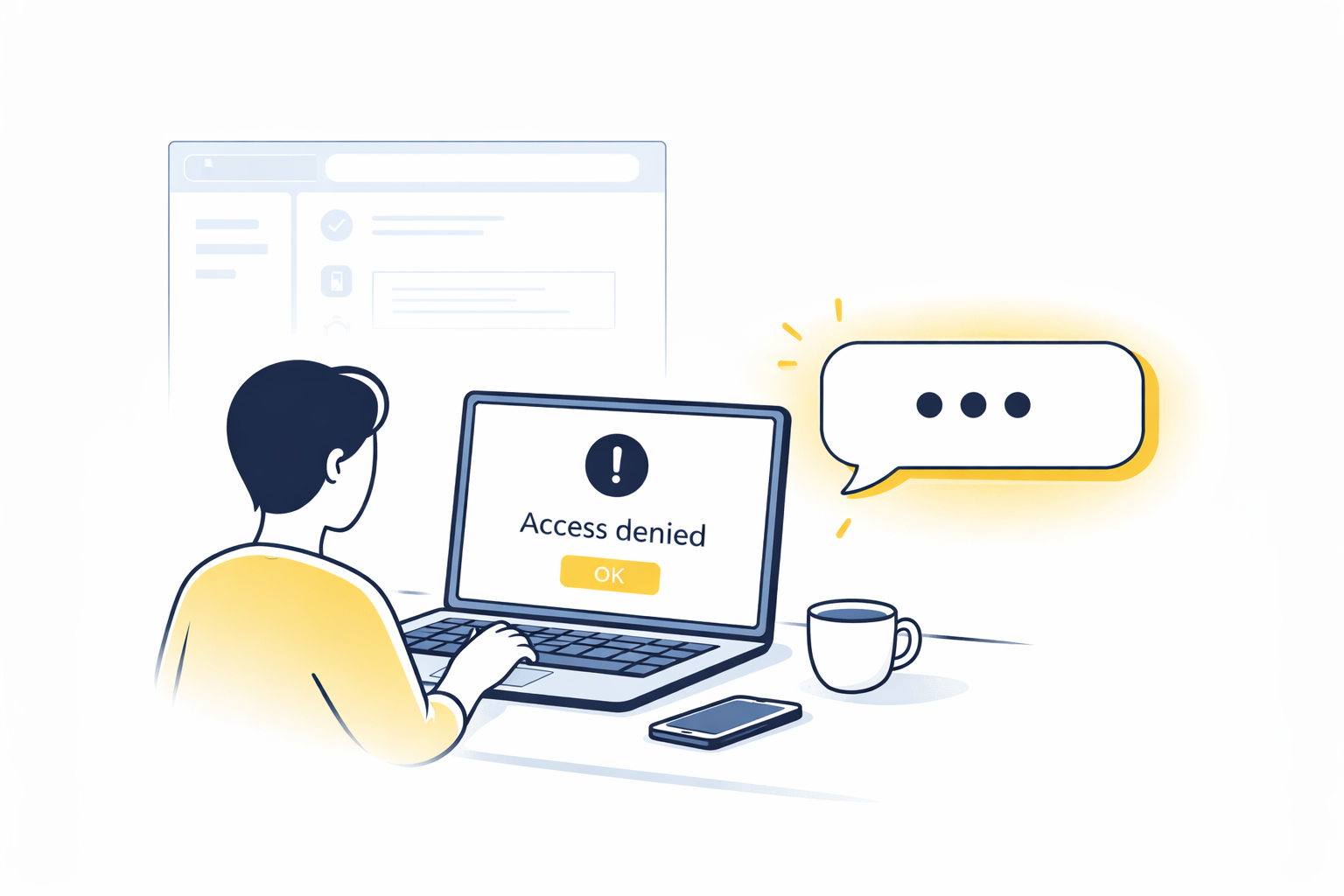
You are five minutes from a meeting. You click a file link and hit an access error. You try again. Same result. Your brain does the quick maths: if you go to the portal, you will need to sign in, find the right form, pick the right category, explain the issue, and hope it lands with the right team.
So you do what most people do now.
You ask in the place you are already working.
That simple moment explains what is happening to the destination portal. Service is no longer a place you go. It is something that meets you where you work, often inside the collaboration tools people already use.
This is not a complaint about portals. Portals were built with good intent. It is just that work has changed, and the way people seek help has changed with it.
The portal tax
Destination portals introduce a tax that is easy to underestimate.
The tax is not just time. It is attention.
To use a portal, a person has to step out of their workflow and become an administrator for a minute. They have to translate a real world interruption into the system’s language. They have to pick the right request type, the right category, the right urgency, and the right wording.
Most of the effort is not about solving the problem. It is about getting the problem into the system.
When the designed path feels heavy, people route around it. They message someone they trust. They post in a channel. They send an email and hope it lands. That is not laziness. It is a signal that the experience is asking for too much effort upfront.
Portals still work well for browsing and discovery. Many service interactions are not browsing. They are interruptions that need a quick, confident path to an outcome.
A simple metaphor: the service platform is the warehouse
A useful way to think about this is to separate operations from experience.
Your service management platform is the warehouse. It holds the inventory and the machinery that make service possible. Workflows, approvals, routing rules, knowledge, audit trails, reporting, ownership.
The portal is a shopfront built on top of that warehouse. It is a designed layer that helps people browse, search, and submit requests.
A shopfront can be well designed and still be a destination. It still assumes that the default way to get help is to leave your work, go somewhere else, and navigate a service experience from scratch.
What is changing is the number of moments that need a shopfront at all.
More and more, people want a counter in the workplace. A place where they can ask a question, request an action, or check a status without losing their thread.
The warehouse stays. The front door becomes flexible.
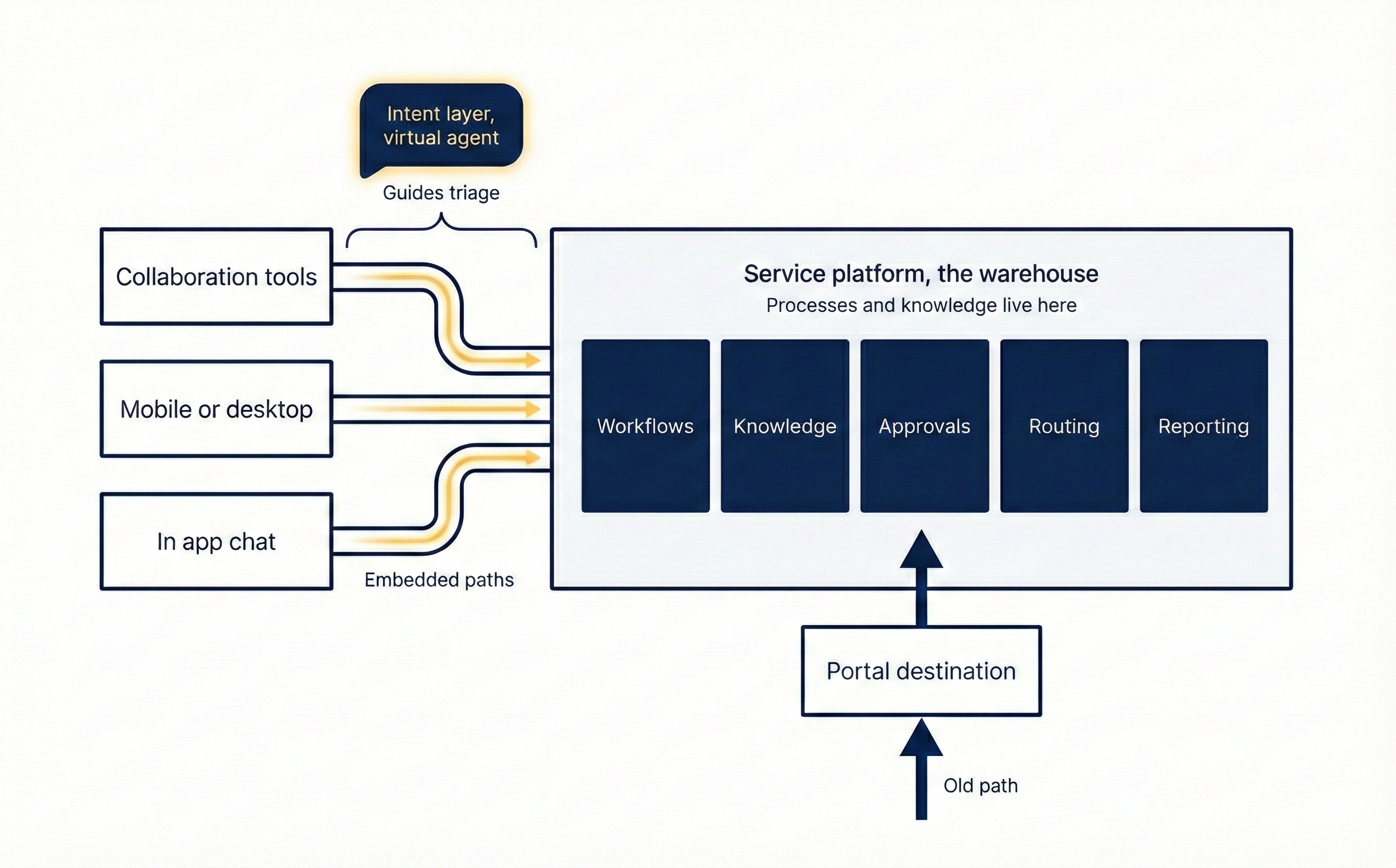
Your service platform is the warehouse. The front door can live wherever work happens.
Why virtual agents are becoming the front door
Virtual agents are becoming a practical front door because they reduce friction. They let people start with a question in plain language, then guide them to an outcome without forcing a detour through forms and menus.
People already behave this way. When something breaks, they start by asking a question in the place they are already working. A virtual agent simply makes that starting point consistent, reliable, and connected to real fulfilment.
For internal service, the goal is not deflection. It is friction reduction.
Friction reduction looks like this:
• Fewer steps to start
• Less time spent searching for the right path
• Fewer back and forth clarification loops
• Clearer status updates, delivered where people will actually see them
• A clean handover to a human when needed, without starting again
In plain terms, it is less admin and more momentum.
Intent first, not portal first
If you want one principle to anchor this whole shift, it is intent first.
People do not think in service taxonomies. They think in needs.
I cannot access the drive.
My laptop is overheating.
Can you add Sarah to this group.
What is happening with my request.
An intent first experience lets the user start there, in their own words, in the channel they are already using. The system then does the organising work behind the scenes.
That is where virtual agents fit naturally. They provide an always available front door that can capture intent, ask only what is necessary, and then route or act.
Recent advances in language models make this easier to do well, because the system can interpret natural language with less rigid scripting. The value is not magic. It is practical. Less forcing the user through menus, more understanding what they meant, and summarising the context cleanly when a human needs to step in.
A good virtual agent does not replace people. It reduces the effort required before people can help.
What we are really saying
If you strip the topic back to first principles, the argument is simple.
The portal assumes service is a destination.
Modern work assumes service should be embedded.
Virtual agents are a scalable way to embed service without turning every request into a manual chat.
That is why this anchors to a bigger narrative about attention.
Tickets measure service workload. Attention measures the cost of getting help.
The destination portal costs attention. An intent first experience returns attention to the business.
How to start, without turning it into a program
You do not need to redesign your entire service catalogue. Start with a small set of high friction moments and design them properly.
- Identify the top five intents that interrupt work
Look for the moments that create urgency and frustration. Common candidates include access issues, device blockers, request status checks, and repeat clarifications. - Pick three Core Journeys to design first (or two if capacity is tight)
Choose intents with clear outcomes and known handover paths. Three is enough to prove a model and learn what good looks like in your environment. - Write the conversation before you build it
Draft the ideal flow in plain language. Capture what the user says, what the agent asks next, what evidence is needed, what triggers escalation, and what the user is told about the next step. - Use the warehouse you already have
Keep your workflows, approvals, and knowledge as the operational backbone. The new experience should surface them at the right moment, not rebuild them. - Measure effort, not just volume
Track time to start, drop-off rate, number of clarification loops, time to first meaningful response, and completion rate without escalation. Those metrics tell you whether friction is actually falling.
Two mistakes show up again and again: rebuilding the portal inside a chat window, and trying to migrate everything at once. If the bot just asks the same ten form questions in a different order, nothing improved. You have built a slower form.
A practical next step
If you want a structured way to identify your best starting intents, map where friction sits today, and shape a sensible pilot plan, you can explore the Intent First Virtual Agent Assessment.
The destination portal is not dying because portals are bad. It is fading because work moved on. Service needs to meet people where they are, with less effort between intent and outcome.