
When I talk to organisations (often around the 2,000 employee mark) about their ITSM platform setup, one of the most common questions I get is:
“What roles do we actually need?”
It’s a fair question, and one without a single right answer. The right team structure depends on where you are in your platform journey and how deeply your ITSM platform is embedded into day to day operations. Whether you’re on ServiceNow, Ivanti, Jira Service Management, or something else, the pattern is usually the same: roles need to evolve as the platform grows.
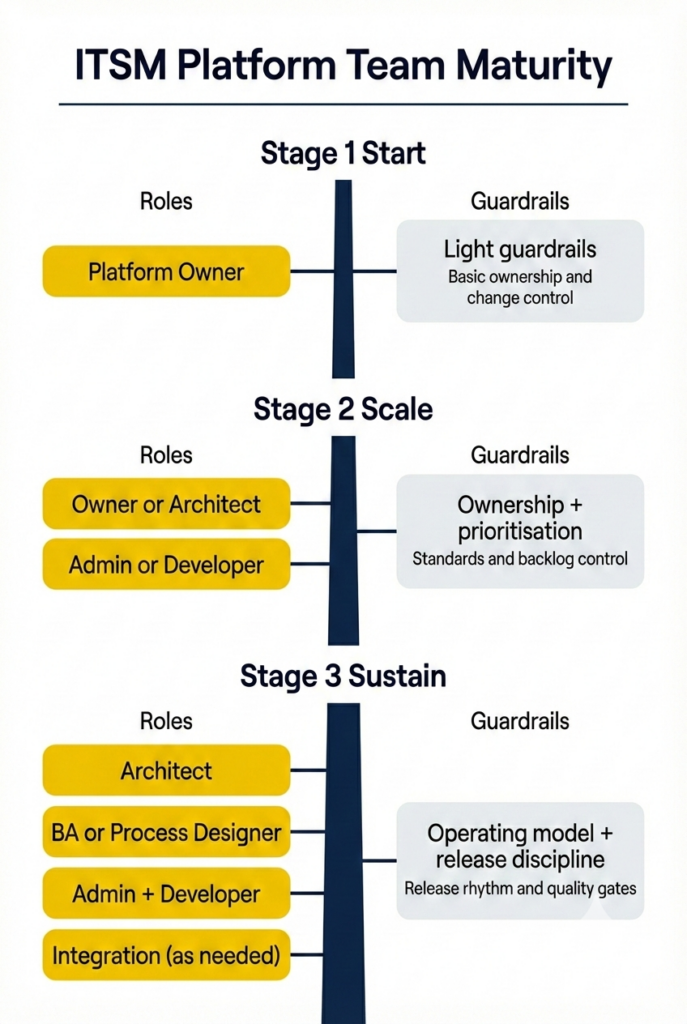
1. Early Stage: Laying the Foundations
If you’re at the beginning, you don’t need a large team yet.
A Platform Owner (or Platform Manager) with hands on configuration experience is often enough to get things moving. At this stage, the priority is getting the basics right: a clean service catalogue shape, sensible workflows, reliable data, and a portal experience people will actually use.
Even though many administrative tasks are simpler than they used to be, the Platform Owner still needs to be technical enough to understand how data models, workflows, integrations, and user experience connect. This role becomes the foundation for early governance, basic integrations, and service design.
2. Mid Journey: Scaling and Integrating
Once you’ve rolled out multiple modules, brought more business teams on board, or started integrating with other systems, the model usually needs to evolve.
A common pattern is a Platform Owner or Solution Architect, supported by a small technical team, often one or two administrators or developers (sometimes offshore). This can work, but it’s also where cracks start to show: growing backlogs, unclear decision rights, and over reliance on one or two key people.
As the platform becomes embedded across departments, the smarter move is to design your team around your operating model rather than copying another organisation’s structure.
For example:
- If your environment is highly process driven (finance, government, regulated industries), you’ll often get more value from a Business Analyst or Process Designer who can translate real needs into workable service journeys.
- If you’re integrating heavily with HR, Facilities, identity, or operational systems, an Integration Specialist can deliver stronger ROI than adding another administrator.
- If upgrades and technical debt are slowing delivery, bringing in a Technical Architect, even part time, can prevent rework and keep the platform stable.
As the platform expands, governance becomes as important as development. Without clear ownership and process control, demand quickly outpaces delivery.
3. How to Tell If Your Platform Team Is Keeping Up
A quick self check usually reveals whether your team has the right mix of roles and enough capacity:
- How many business teams are now live on the platform?
- How many enhancement requests arrive each month, and how long do they take to deliver?
- How many integrations are active, and are they properly owned and maintained?
- How many platform incidents are raised each month?
- Do you have the right balance across configuration, development, architecture, reporting, and governance?
If you’re unsure, that uncertainty is often the first sign your platform has outgrown its current team model.
4. Every Organisation Is Different
There’s no single perfect ITSM platform team structure. What works for a large enterprise won’t suit a smaller education provider or a lean government agency.
The right setup depends on your maturity level, roadmap, and internal capability.
If you’re unsure whether your team structure fits your roadmap, I can help you assess it through a short Platform Capability Review focused on team mix, platform maturity, and roadmap alignment.
There’s always more than one way to solve the problem. The key is finding the structure that fits your stage of growth.