
Testing in ServiceNow often starts informally.
A change is made.
Someone checks the main form.
Someone tests the approval.
A few known scenarios are clicked through.
If nothing obvious breaks, the change moves forward.
That may work when the platform is simple. But as ServiceNow grows, this approach becomes harder to trust.
More modules are added. More workflows depend on each other. More integrations need to behave consistently. More custom applications appear. More teams rely on the platform for day to day work.
At that point, testing is no longer just a technical activity. It becomes a release confidence issue.
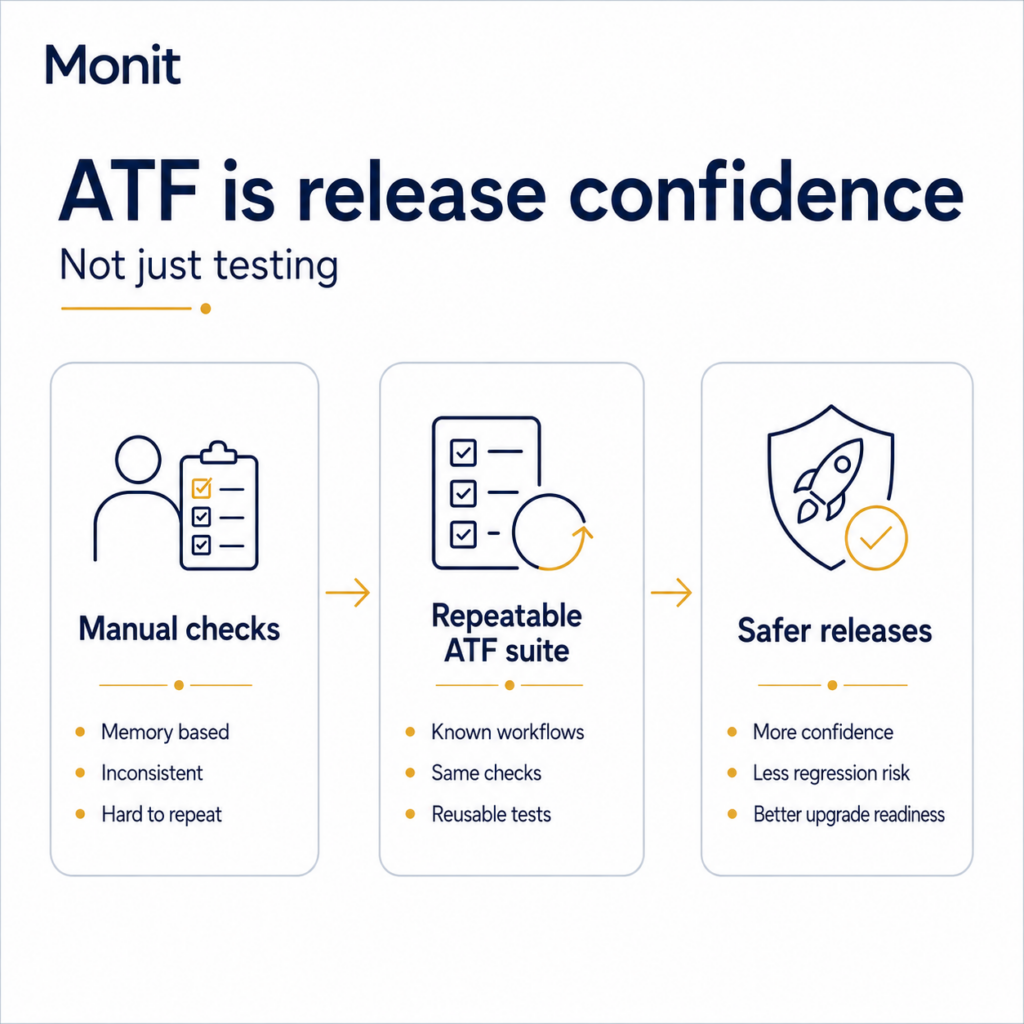
Manual testing gets harder to rely on
Most platform teams do test. The issue is that testing often depends too much on individual memory.
One person knows the approval path that usually causes problems. Another person knows which integration needs to be checked. Someone else remembers the custom field that affects reporting.
That knowledge is valuable, but it is fragile.
It depends on people being available. It depends on them remembering the same scenarios. It depends on validation being performed with the same discipline each time.
As the platform grows, that becomes harder.
Not because the team is careless. Because the platform has become too connected for informal testing to provide enough confidence.
ATF gives testing a repeatable shape
Automated Test Framework can help because it gives common validation work a repeatable structure.
The value is not simply that tests are automated. The value is that important checks can be run consistently, in the same way, as often as needed.
Used well, ATF can support upgrade validation, regression testing, functional testing, business logic testing, and browser based checks across key workflows.
That matters because ServiceNow risks often appear outside the obvious change.
A workflow update may affect approvals, notifications, roles, integrations, reports, routing, or downstream process behaviour.
ATF helps the team ask two important questions:
Did the important things still work after this change?
Did we check them the same way as last time?
The real value is confidence
It is easy to think of ATF as a testing tool.
For platform teams, the better framing is confidence.
Confidence that upgrade validation is not rebuilt from scratch each time.
Confidence that regression checks are not missed because someone is unavailable.
Confidence that critical workflows are tested consistently across releases.
Confidence that change does not rely only on tribal knowledge.
This does not remove every risk. It gives the team a stronger way to manage known risk.
That is especially useful when ServiceNow has become central to how work is requested, approved, routed, and delivered.
The question is not only whether testing exists.
The better question is: Is the testing approach mature enough for what the platform now supports?
When ATF is worth considering
Not every ServiceNow environment needs a large ATF setup.
For a simple environment with low customisation and limited release complexity, a lighter testing approach may be enough.
ATF becomes more relevant when the platform has grown in complexity.
It is worth considering when:
• multiple modules are in use
• custom applications support important work
• integrations rely on stable workflow behaviour
• upgrades require heavy manual checking
• releases regularly create regression risk
• a few people hold most of the testing knowledge
• validation takes too long because everything needs to be checked again manually
These are signs that testing is becoming a platform capability issue.
The question is not simply: Do we have ATF?
It is: Can we validate important change in a way that is consistent, repeatable, and sustainable?
ATF should protect what matters most
ATF does not need to cover everything.
That is where teams can overcomplicate it.
The best place to start is usually with workflows that are important, repeatable, and risky enough to protect.
That might include critical request journeys, approval paths, common incident or change flows, integration dependent processes, custom application workflows, or high volume service processes.
The aim is not to automate every possible scenario. The aim is to protect the workflows that would create the most pain if they broke.
A small, trusted ATF suite is more useful than a large set of tests nobody maintains.
ATF does not replace judgement
A balanced view matters.
ATF is useful, but it does not replace all testing.
Manual review or specialist testing still matters for performance, load testing, report review, email format checking, user experience judgement, and unusual edge cases.
TF is strongest where the process is known, repeatable, and can be verified consistently.
The goal is not to remove human testing completely. The goal is to stop relying on humans for checks that should be repeatable.
Release confidence is a capability issue
ATF is not just a technical feature. It reflects how the platform team manages change.
If testing is inconsistent, releases become harder to trust. If validation depends on individual memory, risk becomes personal rather than systematic. If every upgrade creates a fresh testing scramble, the platform becomes harder to sustain.
A stronger platform team builds routines around release confidence.
That means deciding which workflows matter most, what should be tested repeatedly, how test data is managed, and how tests stay useful as the platform changes.
The tool matters. But the operating discipline around the tool matters just as much.
The question is not whether ATF exists
Most ServiceNow teams know ATF is available. The better question is whether the platform has reached a point where manual validation is no longer enough.
As ServiceNow grows, the cost of weak testing becomes easier to feel.
Releases take longer.
Upgrades feel riskier.
Regression issues appear later.
Confidence sits in the heads of a few experienced people.
ATF will not solve every testing problem. It will not remove the need for judgement. It will not make weak release governance disappear.
But used well, it can help platform teams protect important workflows, reduce avoidable checking effort, and release change with more confidence.
ATF is not just testing. It is one way to make ServiceNow change safer, more repeatable, and easier to trust.
If release confidence depends too heavily on manual checking or individual knowledge, Monit’s Team Capability Assessment can help assess the team practices, governance, and operating rhythm needed to support safer ServiceNow change.