
Most organisations approach GenAI readiness as a technology question.
They compare tools, assistants, connectors, and platforms. They ask which model to use, which interface to launch, or which workflow to automate first.
But once GenAI starts answering real user questions, a different issue usually appears.
The quality of the answer depends heavily on the knowledge underneath.
If the source content is unclear, outdated, mixed, or hard to extract from, even a strong assistant will struggle to produce answers that feel short, useful, and trustworthy. What looks like an AI problem is often a knowledge problem.
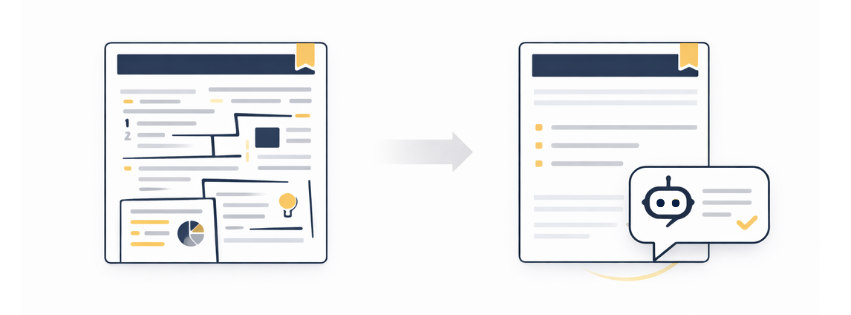
Better GenAI answers start with better structured knowledge.
The model is only part of the picture
It is easy to assume that a poor answer means the assistant is not capable enough.
Sometimes that is true. But in many environments, the bigger issue is that the assistant is working with content that was never designed to support direct answers.
A knowledge article can look perfectly fine to a human reader and still be a poor input for GenAI.
It may cover several scenarios in one page. It may hide the answer deep in the article. It may miss key prerequisites. It may point to an older process that is still published but no longer safe to follow. It may make sense to an experienced support analyst, but not to an assistant trying to generate a grounded answer for someone in the moment.
This is where answer quality starts to break down.
Why this matters more with GenAI
Traditional knowledge channels allow more tolerance.
A person can scan, interpret, skip sections, and fill in gaps. They can often sense when a page feels out of date or when instructions only apply in certain situations.
GenAI works differently.
It retrieves content, interprets it, and turns it into an answer. If the content is noisy, overlapping, vague, or stale, the response can quickly become too long, too broad, or subtly wrong.
That is why early GenAI pilots sometimes disappoint. The assistant may be doing exactly what it was designed to do, but the source content is not giving it a clean foundation.
What weak knowledge looks like in practice
A few patterns show up again and again:
• One article tries to answer several different questions at once
• The answer exists, but it is buried under too much background or repeated explanation
• The steps are correct, but only for a certain team, system, region, or device
• The article is still live, but the process or ownership has changed
• The user needs a request path or escalation point, but the article does not guide the next action clearly
None of these are model problems. They are knowledge design problems.
Good knowledge for people is not always good knowledge for GenAI
This is one of the most useful shifts in thinking.
Many knowledge bases were created for browsing. They were written for people who arrive with patience, context, and some ability to interpret what they are reading.
GenAI answer experiences need something more deliberate.
They need content that is easier to retrieve, easier to extract from, and easier to trust. That usually means one clear intent per article, a direct answer near the top, visible prerequisites, clear steps, and an obvious next action where needed.
In other words, the content has to do more than exist. It has to behave well when used as answer infrastructure.
A better readiness question
Instead of asking whether your organisation is ready to deploy GenAI, it is often better to ask a simpler question first.
Is the knowledge ready to support good answers?
That is a more practical test.
Because when answer quality is weak, users usually do not blame the article. They blame the assistant. Trust drops quickly, and once people stop believing the answer channel is reliable, adoption becomes much harder to recover.
This is why knowledge quality matters so much at the beginning. It shapes whether GenAI feels useful, confusing, risky, or worth returning to.
Start with the knowledge
You do not need to perfect the entire knowledge base before doing anything with GenAI.
But you do need to understand whether the content behind your most important questions is clear, current, structured, and actionable enough to support grounded answers.
That is often the real starting point.
Not the model. Not the interface. Not the launch plan.
The knowledge.
Start with a quick readiness check
If you want a quick way to test this, start with the free GenAI Knowledge Readiness Quick Check. It is a short self assessment designed to help you see whether your knowledge base is ready to support accurate, useful GenAI answers and where the main risks sit first.